Autonomous GIS is now an entry in the Encyclopedia of GIS
I am glad to share that our entry Autonomous GIS is now published in the Springer Encyclopedia of GIS, edited by Shashi Shekhar, Hui Xiong, and Xun Zhou. It went online on October 17, 2026.
This is a completely new entry in GIS. Dr. Zhenlong Li and I established autonomous GIS as a new subfield of GIScience, starting with our 2023 paper Autonomous GIS: the next-generation AI-powered GIS. An encyclopedia entry means the subfield now has a standard reference that students and researchers can cite.
The entry defines autonomous GIS as a GIS that uses the general abilities of generative AI, such as large language models, in natural language understanding, reasoning, and coding to solve geospatial problems. It collects, analyzes, and visualizes spatial data with minimal or no human technical intervention. The entry covers:
- Five autonomous goals: self-generating, self-executing, self-verifying, self-organizing, and self-growing.
- Five core functions: decision-making, data preparation, data operation, memory handling, and core updating.
- Six autonomy levels: from manual GIS (Level 0) to knowledge-aware GIS that keeps learning (Level 5).
- Three scales: local, centralized, and infrastructure.
- Implementation and applications: principles for building GIS agents, and agents for spatial analysis, data retrieval (such as our LLM-Find), cartography, and GIS copilots.
- Future directions: autonomous geographic modeling and self-growing GIS.
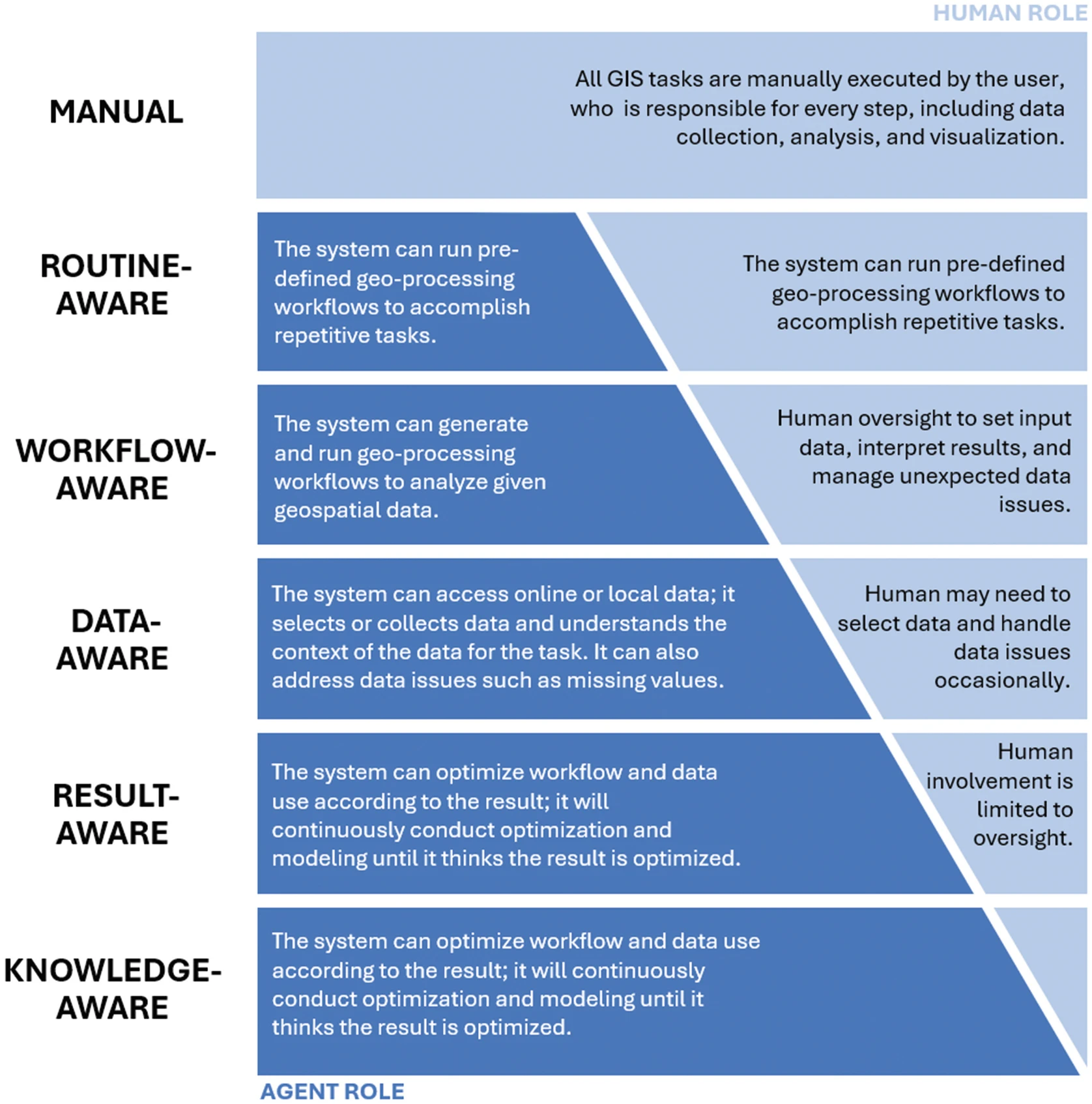
Levels of autonomous GIS: the agent’s role grows and the human’s role shrinks at each level. Figure 1 of the entry, adapted from Li et al. (2025). © Springer Nature Switzerland AG.
Earlier this year, the U.S. Federal Geographic Data Committee adopted our autonomous goals in its Spatial Data Infrastructure Modernization objectives. This entry is another step in building the subfield.
Ning, H., & Li, Z. (2026). Autonomous GIS. In S. Shekhar, H. Xiong, & X. Zhou (Eds.), Encyclopedia of GIS. Springer, Cham. https://doi.org/10.1007/978-3-319-23519-6_1727-1