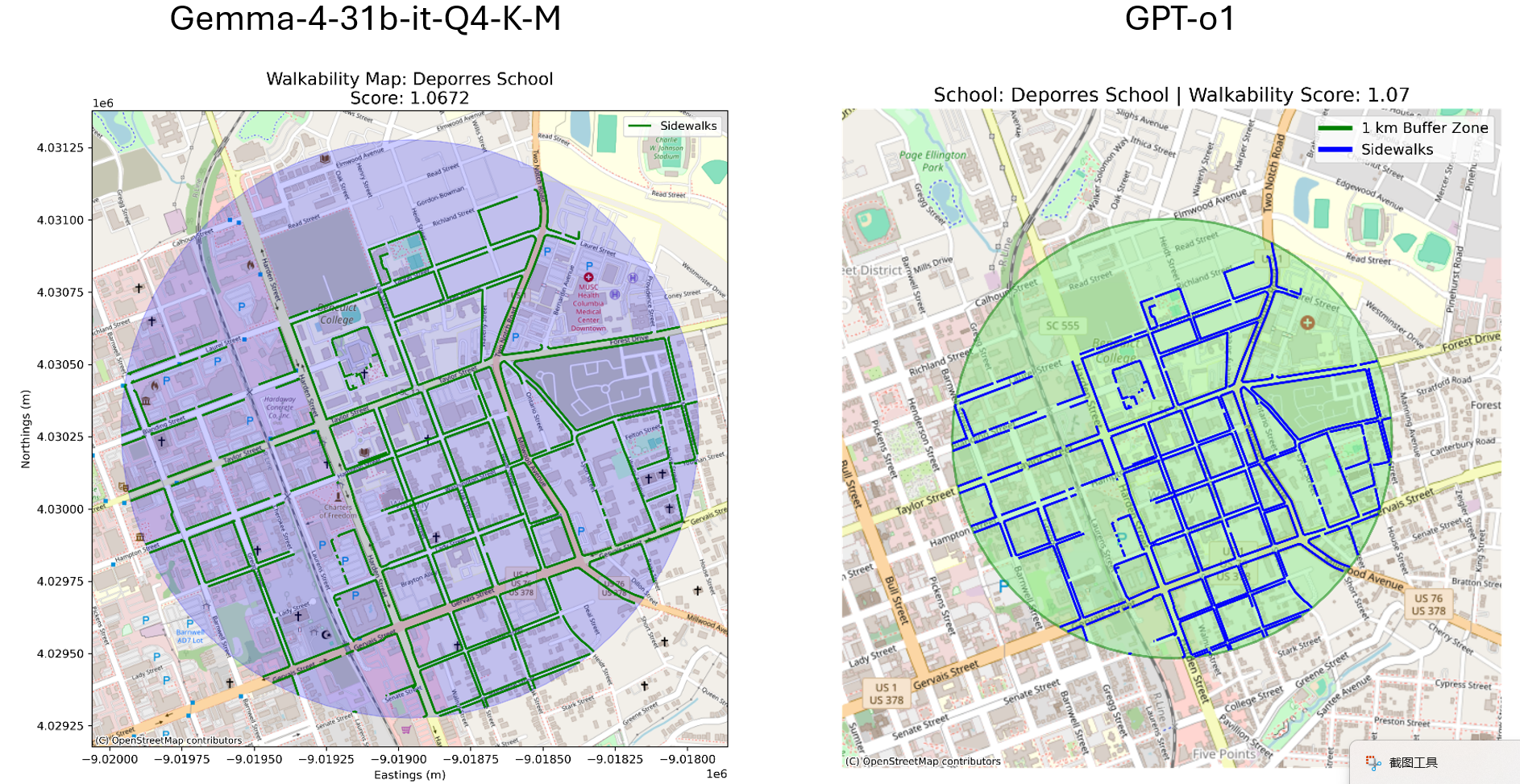
Can a 31B open-weight model handle Autonomous GIS tasks on a single GPU? I tested Google’s new Gemma-4-31b-it-Q4-K-M on an RTX 3090 to find out. 🤖🗺️
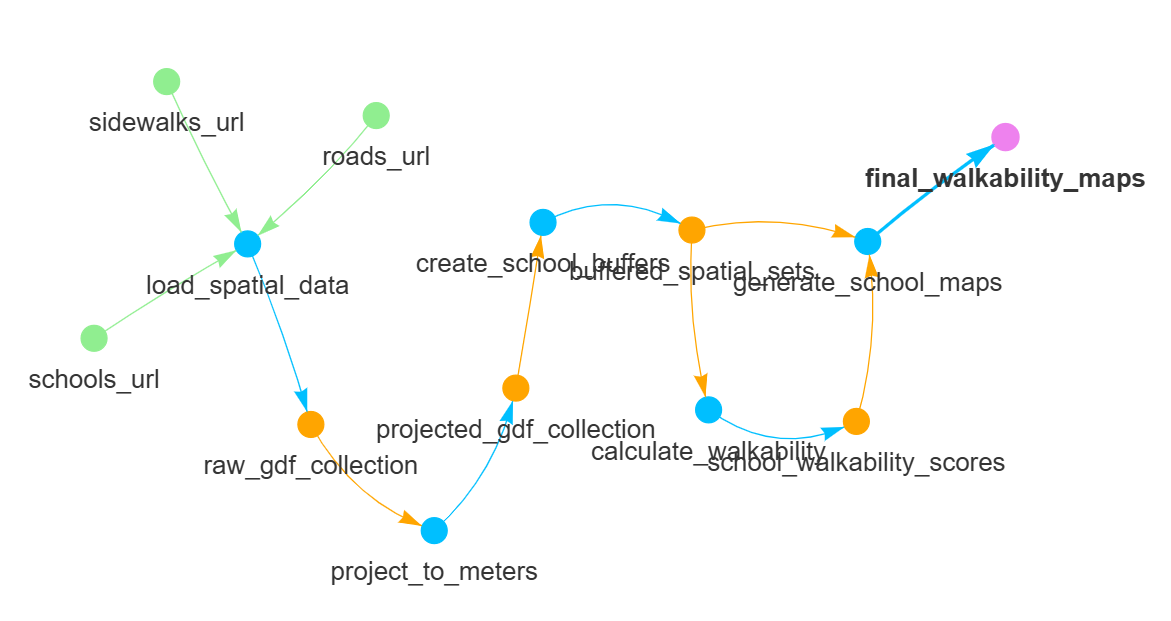
I used my Autonomous GIS agent, LLM-Geo (github.com/gladcolor/LLM-Geo), to run a school walkability case study. The pipeline task:
1️⃣ Generate 1 km study area buffers around multiple schools.
2️⃣ Compute walkability scores (the ratio of sidewalk length to road length).
3️⃣ Map the results with the score as the title, overlaying sidewalks and buffers on an OpenStreetMap basemap.
Frontier models like GPT-5 and Gemini 3 handle this easily today, whereas just recently in 2025, LLMs still required complex exact harnesses—like Directed Acyclic Graphs (DAGs)—to pull this off. So, how did Gemma 4 hold up?
✅ The Good: Surprisingly, this quantized 31B model can complete the entire pipeline. It successfully generated the geoprocessing workflow, implemented the data operations, assembled the programs, reviewed its code, and corrected its own bugs.
❌ The Reality Check: It failed roughly 8 out of 10 trials. Due to its limited parameter size, it simply lacks foundational GIScience knowledge. For example, the model fundamentally struggled to understand how to properly create a 1 km buffer within a WGS 84 geographic coordinate system. Getting it across the finish line required its “think” mode and a lot of heavy prompt scaffolding.
💡 The Takeaways:
- GIScience knowledge is limited: You will hit the ceiling of its domain-specific training quickly.
- Scaffolding is mandatory: It works, but strictly requires heavy structural support to accomplish complex spatial analysis.
- The Time vs. Compute Tradeoff: If your goal is to finish tasks reliably and budget isn’t a concern, stick to the most advanced SOTA models. If you opt for smaller models, expect to spend significant time on knowledge probing and prompt engineering.
Has anyone else tested the Gemma 4 family on domain-specific spatial data? Let me know your results! 👇
#GeoAI #GIS #SpatialAnalysis #Gemma4 #OpenSource #MachineLearning #LLMGeo #Python