The Dopamine Machine: Helping Students Understand the Complicated Addiction Mechanism
Everyday metaphors (a rotor, a brake, a factory and warehouse, recycling pumps, and balance scales) that turn the brain's dopamine pathway into a machine students can watch, plus a driving game, to help students better understand the complicated addiction mechanism.
The Dopamine Pathway is an interactive lesson I built for first-year biology. Its aim is to let students better understand the complicated addiction mechanism, from molecules and cells to behavior. It is a very good material for learning addiction at the molecular level.
The innovation is its metaphors. Neurons, receptors, and transporters are invisible, and their names are hard for first-year students. I spent a lot of time learning the neuroscience and deriving a set of everyday machines that behave the way the real parts do: a rotor, a brake, a factory and warehouse, recycling pumps, and two balance scales. Each metaphor is chosen so that what the machine does on screen matches what the cell or molecule does. Students can then read a drug’s effect directly from the picture instead of memorizing a list.
The machine answers one question. Every addictive drug raises dopamine in the nucleus accumbens, so why are the drugs so different? Because each one breaks into a different part of the same pathway.
The metaphors
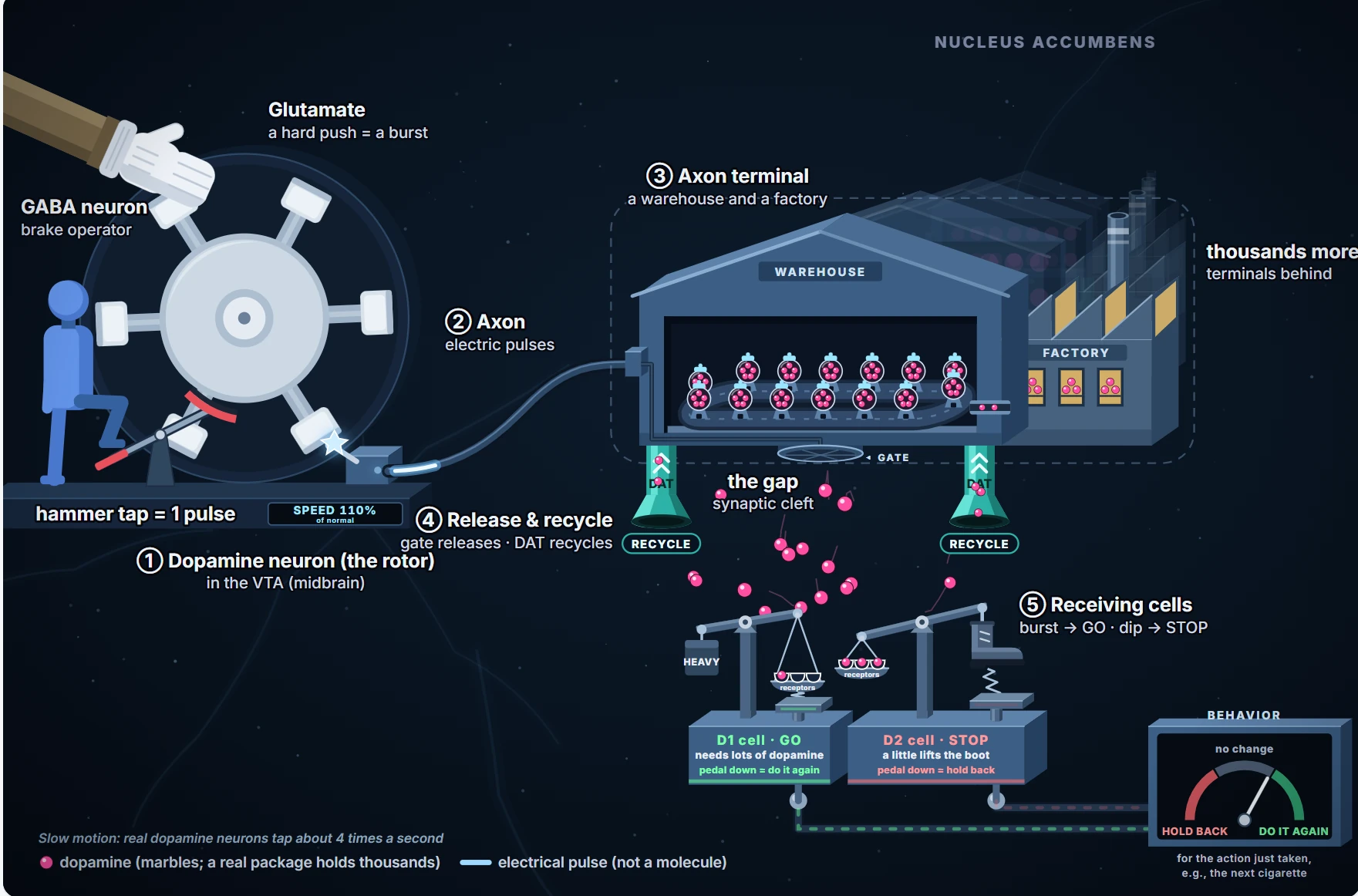
The dopamine machine. Every part is a metaphor for one piece of the real pathway.
- Rotor = dopamine neuron in the VTA (ventral tegmental area). Dopamine neurons are pacemakers: they fire on their own, about four times a second. A rotor also turns by itself, and each hammer tap is one electrical pulse, an action potential. Other neurons can only speed it up or slow it down.
- White glove = glutamate. Glutamate is the excitatory input. A hard push from the glove makes a burst of taps, like the burst of firing after a win or a nice surprise.
- Brake operator = GABA neuron. GABA neurons inhibit the dopamine neuron, so the operator steps on a seesaw brake that presses the rotor’s hub. This metaphor explains disinhibition, one of the hardest ideas in the lesson. Opioids do not push the rotor; they put the operator to sleep, and the rotor speeds up because the brake comes off. Alcohol and cannabis only make him drowsy.
- Keys, sockets, and rockets = receptors. A drug molecule that binds a receptor is a key in a socket on the operator; the more keys, the less he brakes. Nicotinic receptors are rockets on the rotor arms, and nicotine is the key that lights them.
- Cable = axon. The sparks along the cable are electricity. Dopamine does not travel along the axon; it waits at the far end. This corrects a common misconception.
- Factory and warehouse = axon terminal. The factory makes dopamine and the warehouse stores it. Vesicles are gumball machines riding a conveyor belt, refilled through a lid (VMAT2). A pulse opens the gate, and one package empties into the gap at once. Faint copies behind the warehouse remind students that there are thousands more terminals.
- Recycling pumps = DAT (dopamine transporters). The pumps pull dopamine back from the gap to be packed again. With this metaphor, two stimulants become easy to tell apart: cocaine blocks the pumps, while methamphetamine makes the packages leak and runs the pumps backward.
- Balance scales = D1 and D2 receiving cells. Receptors are cups on a scale’s pan. The D1 scale has a heavy weight on its other arm, so only many full cups at once sink the pan onto the GO pedal. The D2 scale holds a STOP boot: a few full cups keep the boot lifted, and a dip in dopamine lets it stamp down. The scales turn receptor sensitivity into something students can see: a burst of dopamine means GO, and a dip means STOP.
- Behavior dial = what the person does next. The pedals send signals to a dial that swings between DO IT AGAIN, no change, and HOLD BACK for the action just taken, such as the next cigarette.
Eight cases run on the same machine: no drug, nicotine, opioids, alcohol, cannabis (THC), gambling and video games, cocaine, and methamphetamine. Opioids put the brake operator to sleep. Cocaine blocks the recycling pumps. Methamphetamine makes the packages leak and runs the pumps backward. Gambling uses no drug at all: a surprise win triggers a burst of firing.
Four ways to explore
Guided story. The machine first runs normally while each part is introduced. Then the drug arrives, and students see exactly which part it changes.
Before & after. Two copies of the machine run side by side, one without the drug and one with it.
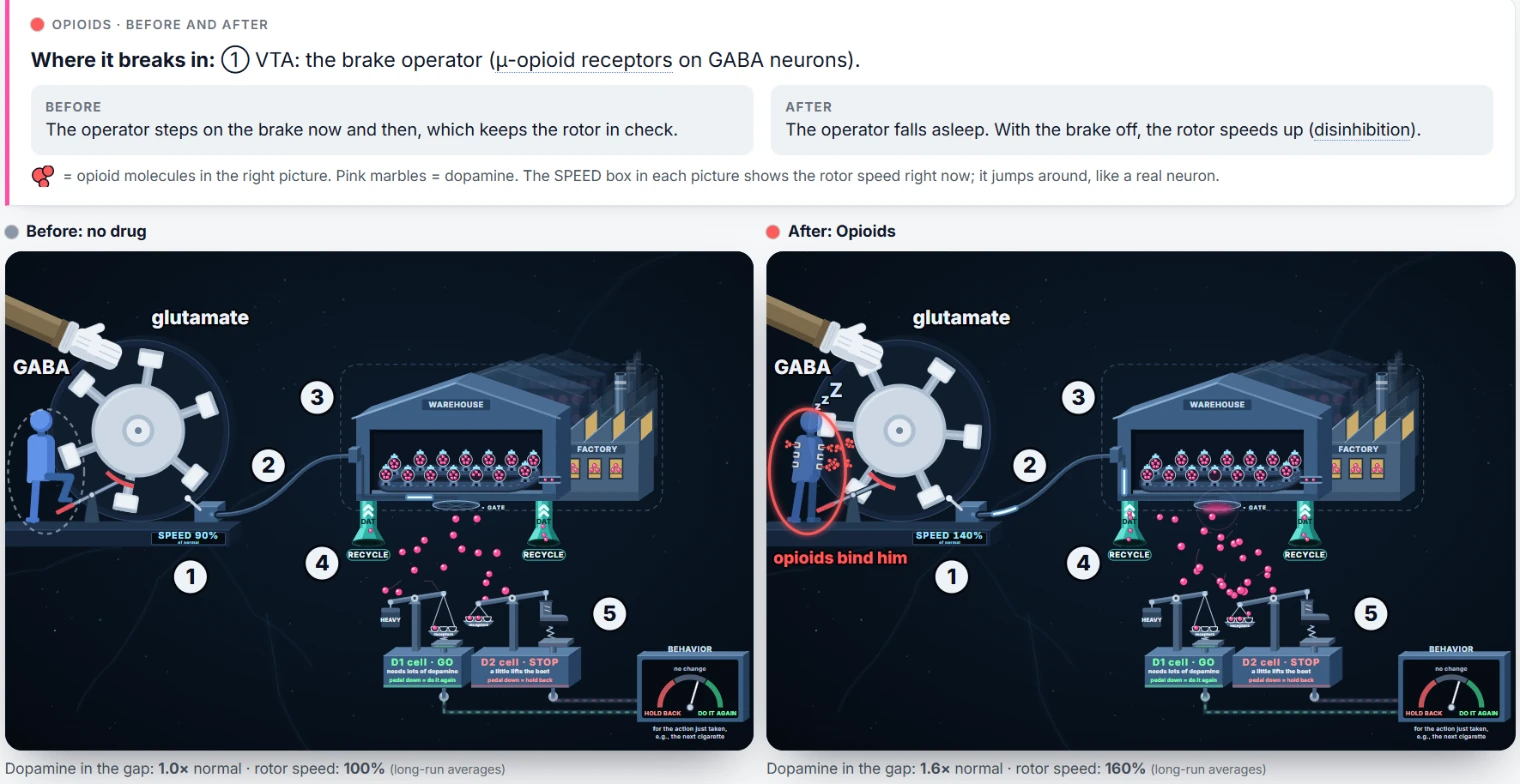
Opioids bind μ-opioid receptors on the GABA neuron. The operator falls asleep, the brake comes off, and the rotor speeds up (disinhibition).
Healthy vs addicted. The same four situations (at rest, an everyday reward, a drug cue, and taking the drug) play in a healthy brain and in a brain after repeated use. Students see tolerance and withdrawal as changes in the machine itself.
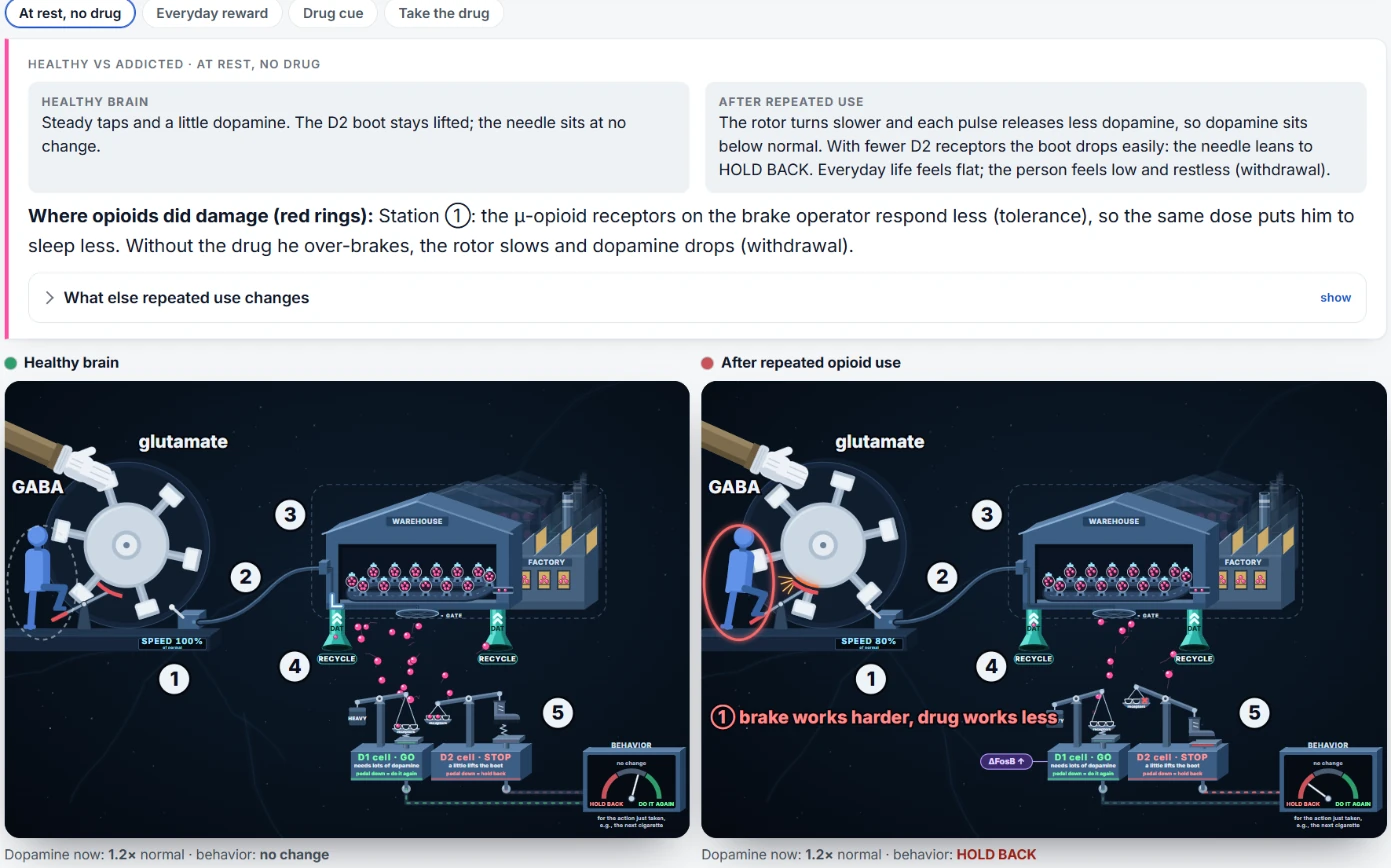
After repeated opioid use, the brake works harder and the drug works less. Without the drug, dopamine drops and everyday life feels flat (withdrawal).
Try it yourself. Students play the drugs’ parts with their own hands on a healthy machine. They hold the glove for a burst, loosen the brake pedal, block a pump like cocaine, make the packages leak like methamphetamine, or tip the scales, and watch what the BEHAVIOR dial does.
The Brake Game: a driving game
After the machine, students drive. The Brake Game carries the metaphors from one pathway to the whole brain: the reward circuit is a car, and its speed is dopamine. The gas pedal is the student’s own “go” signal. Every part of the car is a part of the brain:
| Car | Brain |
|---|---|
| Speed | Dopamine in the nucleus accumbens |
| Engine | Dopamine neurons (VTA) |
| Brakes | GABA neurons (VTA) |
| Steering | Prefrontal cortex |
| Pull toward pills | Hippocampus (craving) |
| Stress alarm | Amygdala (withdrawal stress) |
| Breathing | Brainstem breathing center |
The rules are the rules of real driving. Keep to the speed range (10 to 30 mph in the city, 40 to 65 mph on the highway), stop at red lights, slow down before turns, and don’t hit anything. The goal is to reach day 180, about three minutes of play, with the highest life score.
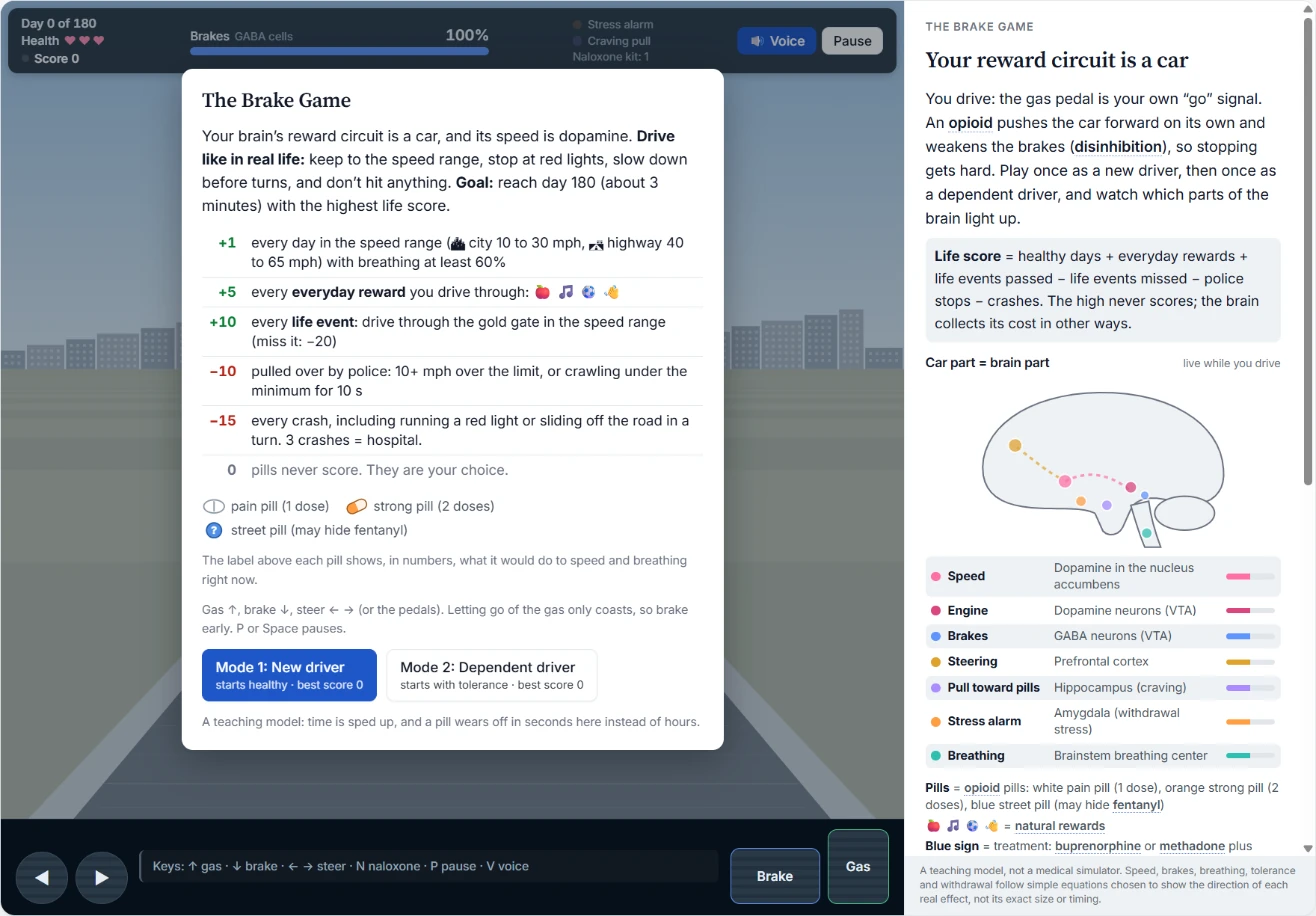
The start screen. Healthy days, everyday rewards, and life events earn points; police stops and crashes lose points. Pills never score.
Students collect everyday rewards such as food, music, and friends for a small dopamine bump, and drive through gold gates for life events. Opioid pills lie on the road beside the rewards, so each pill is a choice. A pill pushes the car forward on its own and weakens the brakes, so stopping gets hard. The breathing gauge is what matters most: an overdose kills by stopping breathing, not by speed. As tolerance builds, everyday rewards feel weaker, and chasing the old high gets more dangerous. The road also has treatment stations (buprenorphine or methadone plus counseling), and every driver carries a naloxone kit.
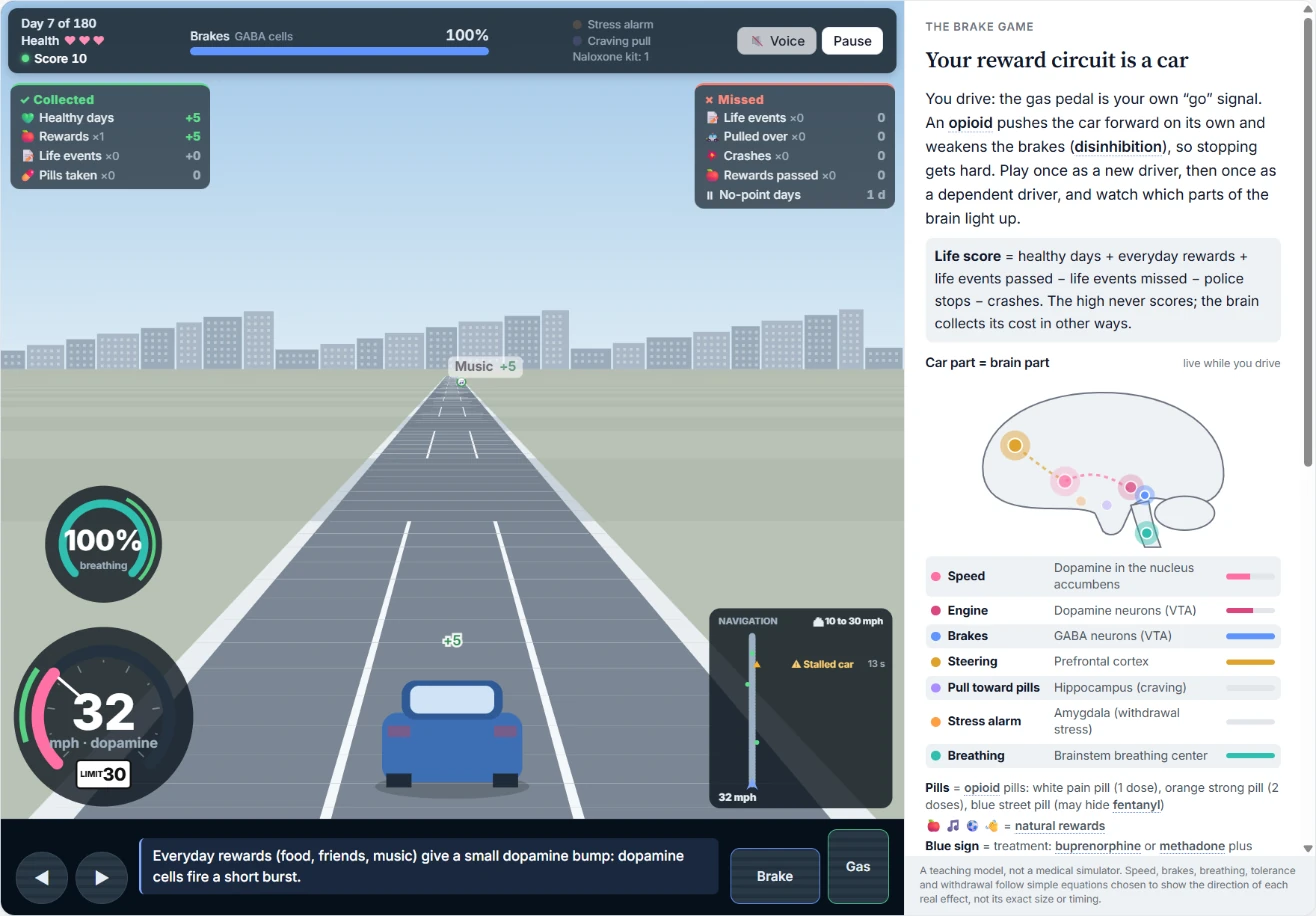
On the road. The speedometer is dopamine, and the brain map on the right lights up live while students drive.
Students play twice: Mode 1 as a new driver, then Mode 2 as a dependent driver who starts with tolerance. In class, the game takes about ten minutes, followed by four discussion questions. The end screen shows where each student’s lost days went: too fast, too slow, or slowed breathing.
Built for the classroom
- Every term comes at three levels: everyday words, biology words, and full names.
- A glossary in the six UN languages, a quiz, and a teacher mode with presenter notes in Chinese.
- Two independent reviews checked all student-facing text against published studies; the accuracy notes list every correction and its source.
- Each page is a single HTML file that runs in a web browser, with 3D views built on three.js.
The pages are teaching models. They show the direction of each real effect, not its exact size or timing.
Links: Open the dopamine machine · Play the Brake Game · All lessons in Addiction in 3D · Source on GitHub