AI in the Shipping Industry: A Practical Application of Drones and Vision Language Models
Drones photograph a cargo ship's draft marks and a vision language model reads them, cutting the inspection from more than an hour to about 15 minutes.
Recently, I was involved in an innovative application of AI in the shipping industry: using drones and vision language models (VLMs) to automate ship draft readings.
When a cargo ship arrives at a port, its draft (the vertical distance between the waterline and the bottom of the ship’s hull) needs to be measured and recorded.
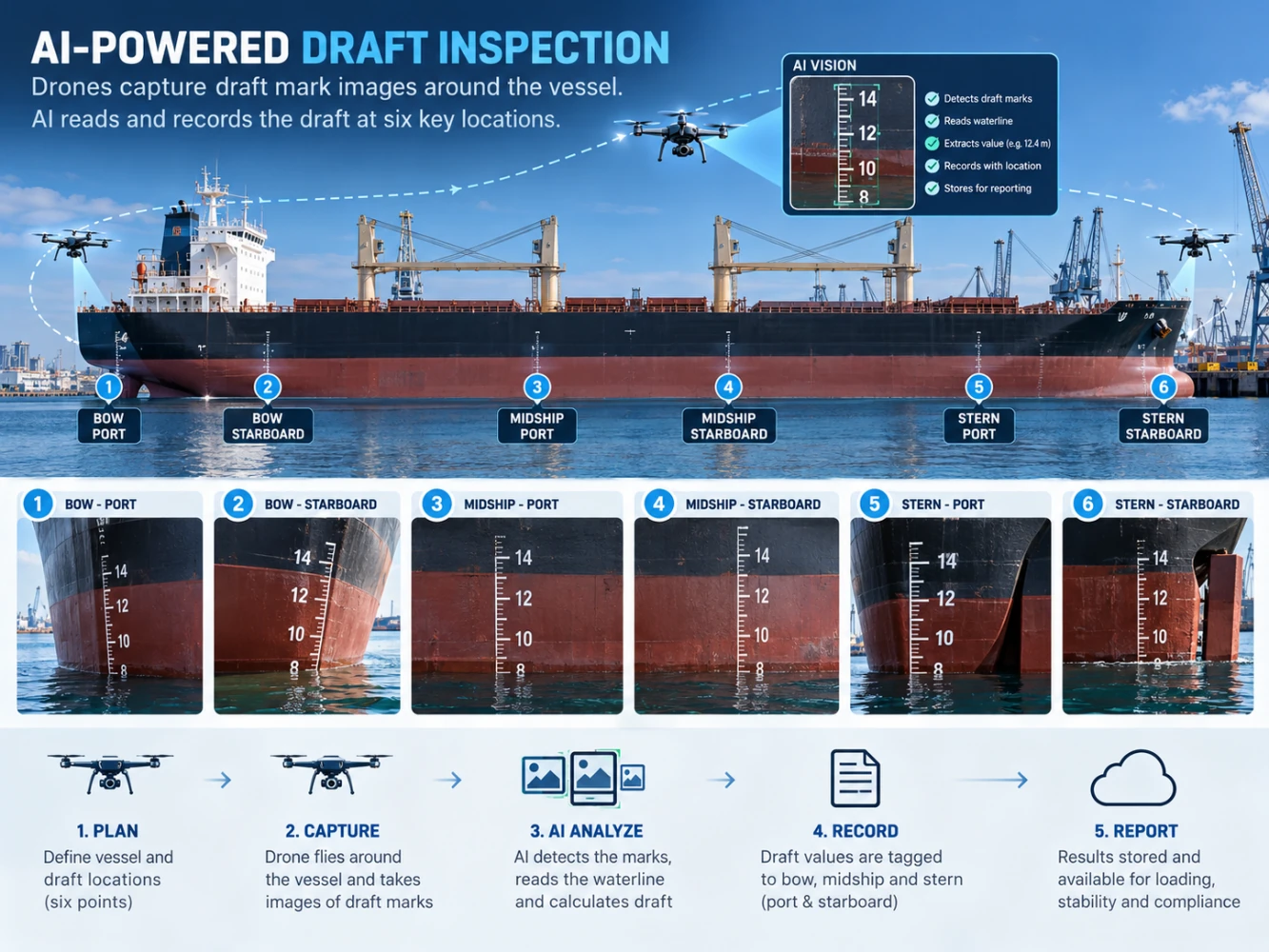
Traditionally, this is a labor-intensive and potentially hazardous task. A surveyor typically boards a small boat, travels around the vessel, and visually reads the draft markings at six locations: the bow, midship, and stern, on both the port and starboard sides.
The innovative team is developing a much more efficient approach:
- Drone-based image collection: A drone flies around the vessel and captures images of the draft markings at the six locations.
- AI-powered interpretation: A vision language model analyzes the images, identifies the markings and waterline, and determines the draft readings.
- Automated reporting: The system records the measurements and generates a report with minimal human intervention.
The goal is to make the entire process fully autonomous.
Of course, several technical challenges remain, including reliable drone navigation and onboard detection of draft markings, robust performance in windy or rainy conditions, and accurate interpretation of markings that may be rusty, faded, or partially obscured.
Despite these challenges, the reported results are promising: the inspection time has been reduced from more than one hour to approximately 15 minutes, while also reducing the need for surveyors to work in potentially dangerous conditions on the water.
The broader implications for employment are still uncertain. However, I see this as a compelling example of how AI can improve productivity and workplace safety by automating a specific, labor-intensive industrial task.
What I find particularly interesting is that this application does not require AI to solve an entirely new problem. Instead, it combines existing technologies, drones, computer vision, and multimodal AI, to transform a traditional workflow.
Sometimes, the most valuable AI innovations come not from developing new models, but from finding the right problems and integrating existing technologies into practical solutions.
First published on LinkedIn on October 25, 2026.