AI for Education: Open Questions from Building Lessons for College and Middle School
This year I built two sets of lessons with AI: addiction lessons for first-year college biology and Genius Classroom for middle school. Building them raised more questions than answers: teaching with AI, teaching AI, personalized learning, adoption by schools, writing as a sign of thinking, and building as a goal of education.
This year I built two sets of lessons with AI. For college, Addiction in 3D teaches first-year biology students how addiction works at the level of molecules and cells, with The Dopamine Machine and the five-minute game Guard the Dopamine Factory. For middle school, Genius Classroom (天才课堂) offers 326 free, bilingual lessons in English and Chinese, where every sentence can be read aloud.
Building them changed how I think about education. I do not have answers yet. These are notes and open questions, and I expect some of them to change as the work goes on.
Teaching with AI: making is cheap, checking is not
A few years ago, an interactive 3D lesson needed a team and months of work. Now one person with AI coding agents can build one in days. For the Dopamine Machine, I spent a long time learning the neuroscience and deriving the metaphors: a rotor, a brake, a factory and warehouse, recycling pumps, and balance scales. I made the teaching decisions, and an AI coding agent turned my rules into code, art, and sound. Genius Classroom goes further: AI drafts the lessons, translates them, and records every sentence in a natural voice.
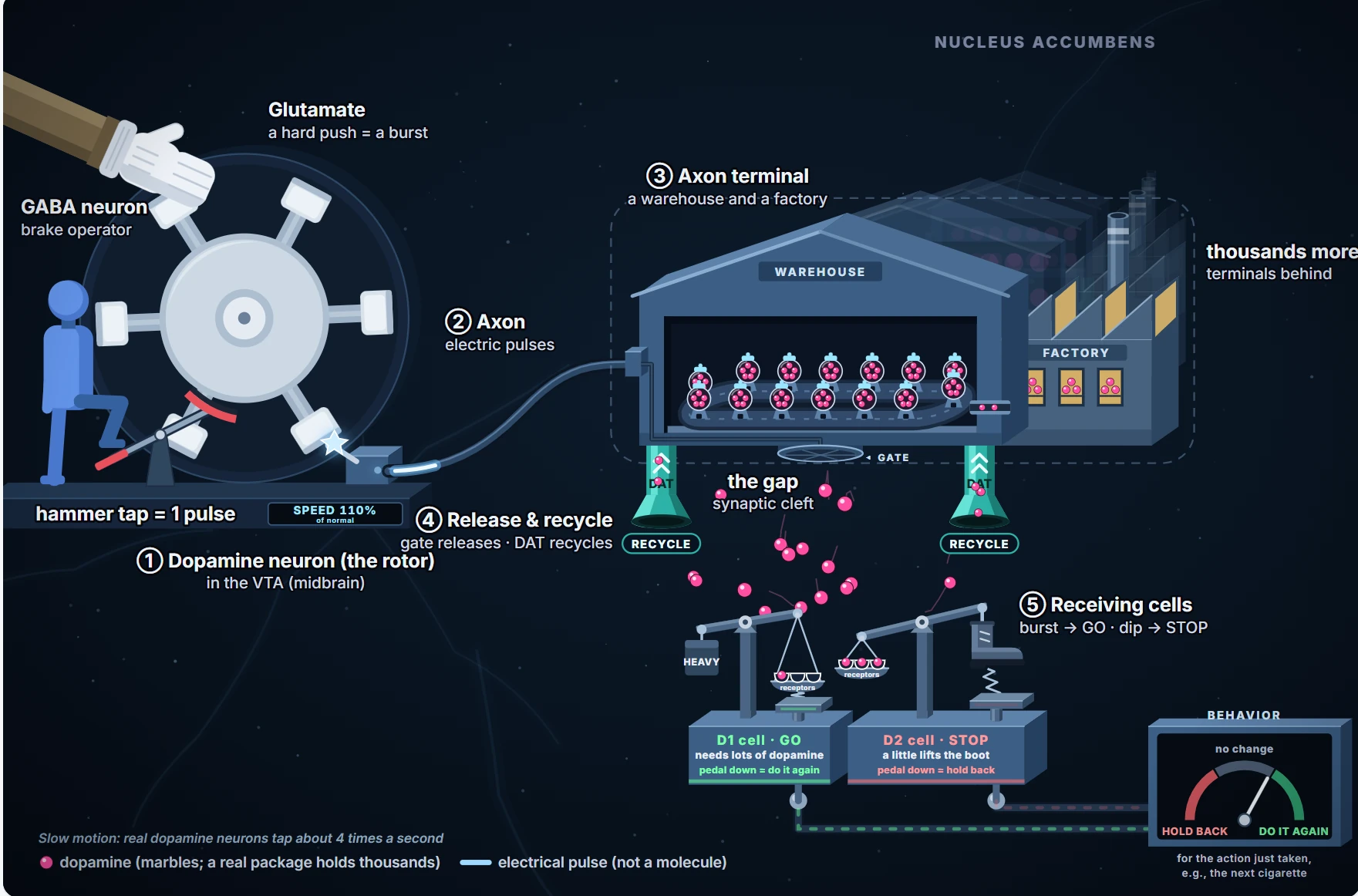
The Dopamine Machine. The metaphors were my work; the code was the AI’s.
What did not get cheaper is checking. A wrong fact in a lesson reaches every student who opens it. So both projects put checking first: two independent reviews checked the addiction lessons against published studies, and in Genius Classroom an independent AI review re-checks every fact, formula, and answer before a person checks the page by hand. The work moved from making to judging.
Who should check AI-made lessons when there are thousands of them? Teachers, publishers, other AI systems, or students themselves?
Teaching AI: someone has to drive
In my own research, an AI agent wrote tedious code quickly but could not judge whether the pixels were right. A person who knows more than the AI had to drive. I think this is the core of teaching AI: students state the goal and the checks first, let the agent draft, then find and fix its errors.
For college students, this belongs in every discipline, because they already use AI every day. For younger students, the question is harder. Reading, arithmetic, and patience with a hard problem still need practice. When should a child start using AI as a tool, and when does it start replacing the practice it was meant to support?
Personalized learning: one lesson, many students
AI makes it possible for one lesson to meet very different students. In Genius Classroom, a student can switch between English and Chinese, hear any paragraph read aloud, and move at their own pace to preview, learn, or review. A student who reads Chinese better can listen to the English lesson; a student who learns by listening can hear the whole lesson. The addiction lessons give every term at three levels, from everyday words to full names, with a glossary in the six UN languages.
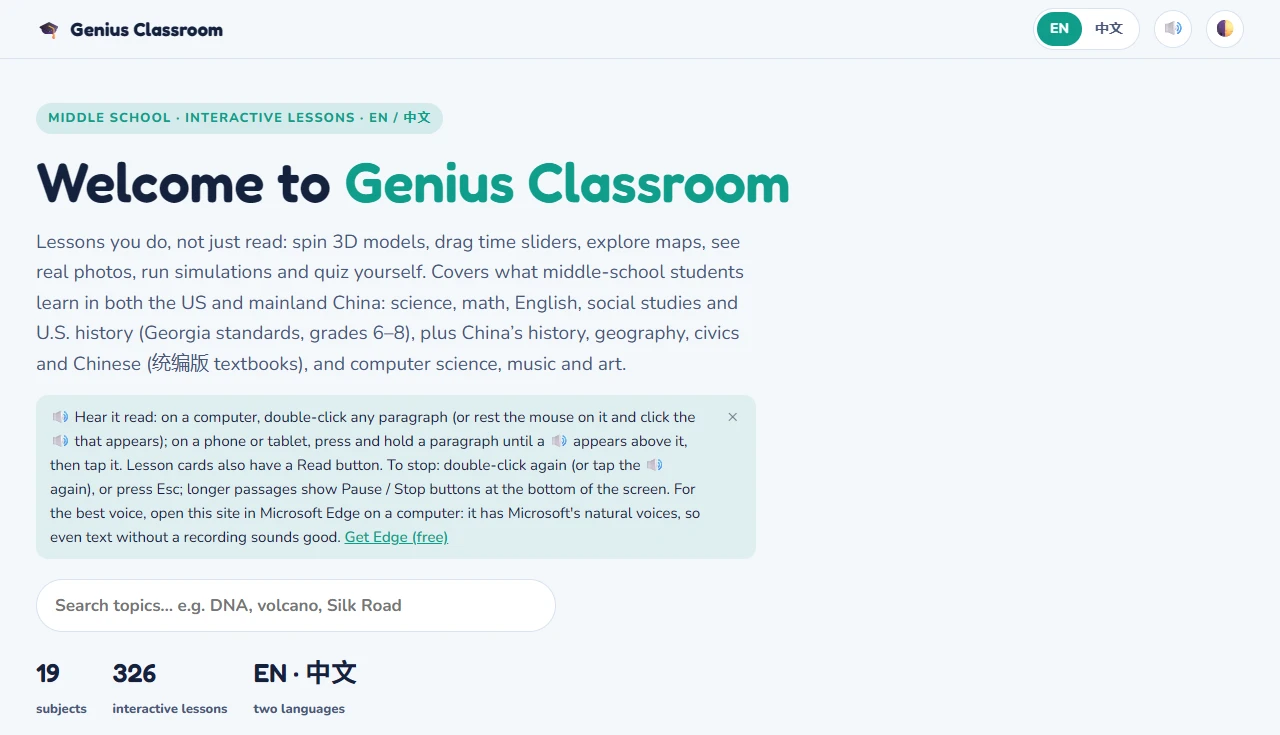
Genius Classroom: bilingual lessons that read aloud, for students in the US and China.
But a lesson that adapts is not the same as a teacher who notices. A good teacher sees confusion on a face and changes the plan. Can AI notice that? And if every student learns alone at their own pace, what happens to the shared experience of a class, where students learn from each other’s questions?
Adoption: tools are easy, trust is hard
Making a tool is now the easy part. Getting it into a classroom is not. Teachers have little time, must follow standards, worry about accuracy and privacy, and plan around a fixed calendar. That is why Genius Classroom follows the Georgia standards and China’s unified textbooks, and why the addiction lessons fit into one class session or a five-minute game. Both are free and run in a web browser. The addiction lessons are openly licensed for other teachers to adapt, and Genius Classroom’s source code is public.
Still, I do not know how a teacher should decide to trust a lesson made with AI. Will adoption come from teachers and parents first, or from schools and districts? And what evidence would convince them? Learning outcomes need real studies, not only good-looking pages.
Is writing still a sign of thinking?
For a long time, essays and reports were how we saw that a student had thought. Now AI writes fluent essays and working code, so a finished product is a weak sign of learning. In my own courses, I plan to assess reasoning more directly: short oral walkthroughs, critiques of an AI answer with planted errors, predictions written before a model runs, and version histories that show how the work grew.
But writing was never only a proxy. For many of us, writing is how we think. If students write less, do they think less, or do they think in other ways? This leads to a deeper question: what is education for? To produce writing, to hold knowledge in one’s head, to form judgment, or, as Genius Classroom puts at its core, to help students discover the beauty in what they learn?
Is building the new goal?
With AI, a student can build an app, a game, or a model in days. Genius Classroom’s motto is “lessons you do, not just read.” Perhaps both the goal and the evidence of learning are shifting from writing about something to building something that works and testing it.
But if AI does most of the building, what does the student learn? When I built the Dopamine Machine, my learning was in the metaphors, not in the code. Building may teach the most when the student has to decide what to build and check whether it is right. Then the goal is not building itself, but the judgment behind it: asking a good question and spotting a wrong result. And for younger students, should building wait until the foundations are solid, or is building the way to make them solid?
I will keep building, and keep asking.