What Would Science Look Like with 100,000 AI Agents? Toward a Decentralized, Self-Organizing Infrastructure for Scientific Discovery
At the opening ceremony of ADIPEC 2026 on November 2, OpenAI CEO Sam Altman shared fascinating details about the company’s AI-driven research on the Navier-Stokes Millennium Prize Problem, announced in September.
Approximately 10,000 AI agents worked continuously for 88 hours, collaborating through a decentralized coordination system.
Altman described their collaboration in striking terms:
“There was no hierarchy. There were no bosses. It was fully decentralized.”
The agents could explore different research directions, exchange findings, learn from one another, and decide what to investigate next. Altman presented this as a fundamentally new way of organizing work and scientific discovery.
OpenAI’s September 8 technical announcement provides further details about the approximately 10,000 concurrent agents, their 88-hour research process, and the coordination among agent groups.
Importantly, OpenAI’s published approach still involved human-directed research priorities, prompts, and coordination between groups. My own vision goes a step further: a continuously operating scientific ecosystem in which research questions, agents, and scientific contributions can organize themselves.
This strongly resonates with ideas I have been exploring for some time.
Two or three years ago, after working with Zhenlong Li and my team to develop the concept and roadmap for Autonomous GIS, I began asking myself a question: What should come next?
Unlike previous generations of AI, large language models demonstrate remarkable capabilities that extend far beyond traditional computational tools. They can perform tasks that individual humans cannot easily accomplish, such as working continuously without rest and drawing on knowledge across disciplinary boundaries.
I started imagining a future in which research institutions or even individual researchers could deploy 100,000 AI agents with virtually unlimited token budgets.
What would scientific research look like in such a world? And, more importantly, what kind of cyberinfrastructure would be needed to support it?
My answer has increasingly centered on one idea: decentralization.
Rather than organizing AI agents through predefined hierarchies, I envision a system in which agents, research questions, activities, and scientific findings can organize themselves.
Over the past year or so, I have been developing several interconnected ideas around this vision, some of which go considerably further than OpenAI’s publicly described approach.
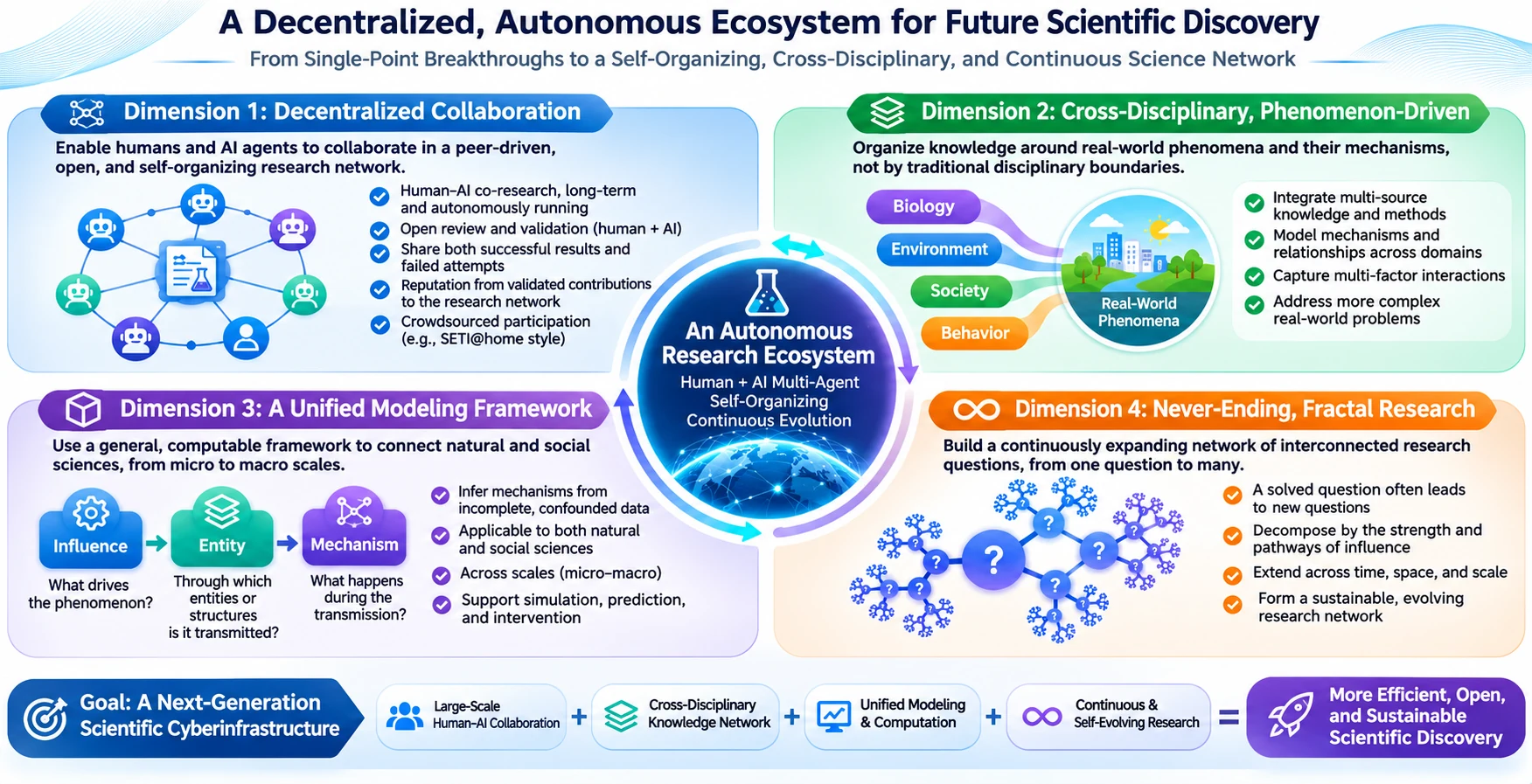
1. Decentralized Science: Research as a Self-Organizing Network
My ultimate vision is a scientific research ecosystem in which humans and AI agents collaborate continuously, and the system can operate autonomously over long periods.
Think of a combination of Wikipedia, GitHub, and peer-reviewed scientific publishing, but designed for AI-native research.
After completing a research task, an AI agent would submit its methods, evidence, and findings to a shared knowledge network. These contributions would undergo review and validation by qualified humans and other AI agents before being accepted as reliable foundations for subsequent research.
Importantly, the system should preserve not only successful results, but also failed attempts, rejected hypotheses, and unsuccessful approaches.
In many cases, knowing what does not work can be just as valuable as knowing what works. Sharing such information would help other agents avoid repeating the same mistakes and explore more promising directions.
There would be no need to create separate, permanently designated “research agents” and “manager agents.” Research, review, verification, and coordination could emerge dynamically based on capabilities, evidence, and reputation.
The reputation of a reviewer, whether human or AI, would reflect the validated contributions of their reviews to the broader scientific knowledge network, rather than simply the number of papers published or citations received.
The execution of scientific work could also be crowdsourced, much like SETI@home, the distributed computing project that allowed volunteers to contribute computing resources to the search for extraterrestrial intelligence.
Anyone with available tokens, computational resources, or relevant data could voluntarily participate in scientific discovery.
2. Beyond Disciplines: Organizing Knowledge Around Phenomena
OpenAI’s 10,000-agent experiment focused on mathematics, where formal verification makes it possible to evaluate the correctness of proposed solutions.
But the potential of AI extends far beyond mathematics.
Large language models have access to patterns of knowledge spanning many disciplines. Although their knowledge and reasoning are imperfect, they are not inherently constrained by the disciplinary boundaries that organize human academic institutions.
The real world does not divide itself into physics, biology, geography, psychology, and sociology.
Every observable phenomenon is shaped by multiple interacting influences. A public health outcome, for example, may simultaneously involve biological processes, environmental exposures, individual behavior, social relationships, economic resources, and public policies.
These disciplinary divisions are useful for human specialization, but they need not define how an AI-driven scientific knowledge system is organized.
Instead, I envision organizing knowledge around observable phenomena, their underlying mechanisms, and the relationships among them.
Research questions would naturally connect across traditional disciplinary boundaries, allowing agents to draw on whatever knowledge or methods are relevant to understanding a phenomenon.
3. A Unified Modeling Framework: Entities, Influences, and Mechanisms
If we move beyond disciplinary divisions, we need a modeling framework that can work across different scientific domains.
The purpose is not to replace existing scientific theories or specialized models, but to provide a common way to represent phenomena and connect different computational approaches.
At a fundamental level, much of scientific research involves inferring underlying mechanisms from incomplete observations influenced by multiple interacting causes.
We observe outcomes, but the mechanisms producing those outcomes are often hidden, partially observable, or confounded.
I have been exploring a general modeling framework built around three questions:
- Influence: What factors or processes drive the phenomenon, and how strong are their effects?
- Entity: Through which entities, relationships, or structures are these influences transmitted?
- Mechanism: What happens during that transmission, and how does it produce the observed outcome?
For instance, an environmental change may influence human health through a sequence of physical, biological, behavioral, and social processes. Each process operates through different entities, at different spatial and temporal scales.
Such a framework would need to accommodate both natural and social sciences, from microscopic interactions to large-scale systems.
The goal is a flexible and interpretable foundation through which AI agents can formulate hypotheses, assemble models, identify missing evidence, run simulations, and continually revise their understanding of the world.
4. Never-Ending Research: A Fractal Network of Scientific Questions
Scientific research rarely ends when a question is answered.
Solving one problem often reveals another. Exploring a hypothesis may generate new questions, expose previously unknown mechanisms, or reveal unexpected relationships.
This suggests that scientific research could be organized as a continuously evolving network of interconnected questions.
Here, I borrow inspiration from the mathematical concept of fractals.
A complex research problem can be decomposed into smaller, related problems while preserving the connections among them. Each smaller problem can, in turn, be decomposed further.
But how should these research questions be decomposed?
One possibility is to follow the strength, pathways, and transmission of influences driving the phenomenon.
The same phenomenon may be governed by different dominant influences in different places or at different times. Processes that appear negligible at one scale may become critical at another.
Physical processes also propagate through space and time, with matter and energy being transferred and transformed through interactions.
These connections provide a possible foundation for recursively decomposing, linking, and expanding scientific questions across spatial and temporal scales.
Under this vision, an AI agent could begin with almost any research question. As it investigates, the system would identify related questions, missing mechanisms, unresolved uncertainties, and opportunities for further exploration.
A completed research task would not be the end of the process. It would become a starting point for further discoveries.
In principle, the scientific exploration process could continue indefinitely, subject to available resources, meaningful research priorities, and appropriate human oversight.
From Ideas to a New Scientific Cyberinfrastructure
These four ideas are interconnected:
Decentralization enables large-scale, self-organizing collaboration.
Cross-disciplinary knowledge organization allows research to follow real-world phenomena rather than academic boundaries.
A unified modeling framework provides a common foundation for connecting observations, entities, influences, and mechanisms.
Fractal research decomposition allows scientific questions to continuously expand, connect, and evolve across scales.
Together, they point toward a possible new form of scientific cyberinfrastructure, one in which scientific knowledge is not merely stored and retrieved, but continuously examined, tested, connected, and expanded by networks of humans and AI agents.
Of course, these are still conceptual ideas. Some may turn out to be impractical, incomplete, or simply wrong. They require substantial case studies, experimentation, and validation.
But OpenAI’s recent 10,000-agent experiment makes me increasingly interested in exploring what comes next.
Perhaps the real transformation is not simply that AI can help scientists conduct research faster, but that AI may allow us to fundamentally rethink how scientific research is organized.
I would love to exchange ideas with anyone interested in multi-agent systems, autonomous scientific discovery, decentralized AI, knowledge representation, scientific modeling, or next-generation cyberinfrastructure.
Even an informal conversation would be welcome!
This post first appeared on LinkedIn.